CC License

Saturday, March 22, 2025

نشر القطع الأثرية نشر غير علمي سواء محلياً أو دولياً

أرى أن الباحثين الذين ينشرون القطع الأثرية المصرية نشر علمى هو فى حقيقة الأمر بعيد كل البعد عن العلمية لأنه يتغاضى عن ظروف خروج هذه القطع من مصر سواء فى القرون الماضية تحت الإحتلال أو فى الوقت الحالى. كل ما يهتم به الباحثين إتباعا لنهج الباحثين الإستعماريين فى الغرب هو النص وهو أمر فيه تقليد أعمى وليس من العلمية فى شئ.

نمط معروف

وهذا النمط معروف جداً لكل من يعمل بالاثار أو مهتم على حسب تخصصه بنوع معين من الآثار، فأنا على سبيل المثال كمتخصص فى البرديات اليونانية أرى هذا النمط تقريبا مع كل قطعه أنشرها أو نشرتها. ولقد تحدثت عنه مرار وتكرارا فى العيد من المناسبات العلنية والبحثية سواء داخل مصر أو خارجها. وكشفت فى ذلك عن أسباب هذا التغاضى وهي أسباب ترتبط بالمصلحة الشخصية سواء مصلحة الباحث الشخصية فى الترقي و إظهار أنه يستطيع أن ينشر علمياً مثل الخوجات وفى هذا توقير له على المستوى المحلى ثم تعزيز لروح الغرور الغربى بأنهم يقلدونا تقليد أعمى ولا يعرفون ما يفعلون .


ليست قضايا منفصلة ولكنها عمل منهجى ومؤسساتى

أما من ناحية المؤسسة التى تحتفظ بالقطعة الأثرية فى الغرب فهناك مصلحة مباشرة فى عدم التنقيب عن أصل خروج هذه القطعة أو تلك من مصر لأنهم فى نهاية المطاف ملزمين بإرجاعها إلى دولة المصدر إن هم علموا أنها مسروقة وفى الحقيقة أن أغلب القطع التى خرجت من مصر تعتبر فى رأي مسروقة أو خرجت بالإحتيال والنصب كما فى هذه العملية الأخير التى كشتف عنها العديد من الصحف المحلية والعاليمة . والعملية ليست من السهولة بمكان للتغاضى عنها بل هي عملية متصلة ومتواصلة ولها ما يعززها على الصعيد الأثرى والسياحى والبحثى .حسب أوراق القضية تركز نشاط عصابة التهريب في 3 محافظات، وهي الشرقية والغربية والبحيرة، وشملت بخلاف أشرف الضرير الذي يتولى بيع الآثار في أمريكا مفتش آثار بمنطقة آثار وسط الدلتا، ورئيس بعثات أثرية محلية ودولية استغل وظيفته كمفتش آثار بمنطقة آثار الغربية في إمداد "الضرير" بمعلومات عن الأماكن الأثرية، فضلا عن مشاركته في إجراء عمليات التنقيب عن الآثار."

عملية معقدة وتحتاج إلى كثير من البحث العلمي للخروج بحلول عملية

العملية معقدة للغاية وابعادها لم تكشف بعد لأسباب عديدة من اهمها أن العملية كانت ولازات مربحة للغاية لجميع الأطراف سواء المصريين الذين ينقبون عن الآثار أو المهربين أو من يشترى الآثار فى الخارج فى المعارض أو حتى الأكاديميين.

للمزيد أنظر:
  • تحقيق أحوال مصرية هنا
  • تحقيق باب مصر هنا
  • تحقيق العربى الجديد هنا

Wednesday, February 12, 2025

Manufacturing Silence in Antiquity-related displines

Manufacturing silence in antiquity-related disciplines

I have long wondered, along with other colleagues, why there is silence in most disciplines related to antiquity. I think there is an atmosphere of fear among those who are silent. The title of this post says what I think the reason is. I believe that this silence and fear is manufactured. I am referring, of course, to the famous book Manufacturing Consent: The Political Economy of the Mass Media by Edward S. Herman and Noam Chomsky (1988). Wikipedia, linked above, says of the book that it "argues that the mass communication media of the United States are effective and powerful ideological institutions that perform a system-supporting propaganda function by relying on market forces, internalised assumptions, and self-censorship, and without overt coercion" through the propaganda model of communication. The title refers to the consent of the governed and derives from the phrase "the manufacture of consent" used by Walter Lippmann in Public Opinion (1922). Manufacturing Consent won the Orwell Prize in 1989 for "outstanding contributions to the critical analysis of public discourse". 


While public discourse is an important factor in the production of silence in antiquity-related disciplines, what I am referring to here is the production of silence in the academic discourses of these disciplines: take, for example, papyrology, in which I have not only studied at the ASU in Cairo, where I am currently a tenured lecturer, but in which I have a Ph.D. from the University of Heidelberg. There are many techniques used to produce silence in this discipline. I will not offer a comprehensive analyssis of this now, but I will start reflecting on it by refering to the most important factor in this process. Fear in my opnion is the most important factor. 

Silence in academia can often stem from fear - fear of backlash from peers, institutions or funding bodies. This can discourage researchers from challenging established narratives or exploring controversial issues, perpetuating a cycle of silencing certain ideas. It is important to distinguish between imposed and internalised silence. Academic institutions can create environments where silence is cultivated through hierarchical structures. Scholars may feel pressured to conform their work to dominant paradigms or to avoid deviating from accepted methodologies, leading to the suppression of alternative perspectives. On the other hand, scholars in antiquity-related disciplines may internalise expectations of acceptable discourse. This can lead to tacit agreements about what topics are 'safe' to explore, limiting intellectual diversity and innovation.

I do not belong to either of these traditionalist groups, but to those who are thinking about alternatives. You could call this group the marginalised or the minority among academics, but they exist and they support each other. There are different types of minorities. The first are those who are really a minority, and those who offer new, unconventional perspectives even though they are part of the majority. Both types of scholars from underrepresented backgrounds or those proposing unconventional ideas may find themselves isolated. The lack of mentorship, funding or institutional validation can further entrench silence and complicate the issue in academic settings.

Another important factor, which also relates to the book mentioned above, is public discourse. While public discourse is essential in shaping societal values, its influence can also limit academic freedom. Scholars may feel compelled to engage publicly in ways that are in line with popular sentiment, even if these perspectives differ from their research findings. This kind of control over research findings is exercised through the peer review process in the publishing industry. It is another key factor in the whole process. The pressure to publish can lead scholars to produce work that conforms to existing trends rather than challenging them, resulting in a lack of critical engagement with the silence in ancient studies. This is not to say that there are no scholars who critically engage with the issue of silence. No, on the contrary. There are always courageous scholars who try to do serious scholarship, either parallel to the traditional or completely revolutionary. I believe that addressing this complex issue requires more than ranting about it in a blogpost. It requires creating such safe spaces for dialogue, as we have done with Everyday Orientalism, promoting inclusivity beyond slogans, and advocating for academic freedom. In this initiative we have been encouraging interdisciplinary collaboration beyond the traditional boundries of ancient studies, which can also provide opportunities for silenced voices to emerge and be heard.

In summary, my reflections, or my rantings if you wish, highlight the complexities surrounding silencing in academia, particularly in disciplines related to antiquity. Addressing these issues requires thoughtful action that prioritises transparency, open dialogue, and support for diverse scholarly voices. Encouraging conversations about fear and silence can foster an environment conducive to critical analysis and constructive discourse in the field. Oh, and do you wonder why I started this rant. Look at this piece in the New York Times about smuggling artefacts from Eygpt, a topci and research area which is silenced in papyrology from the very begining. That is the topic of current research project about colonized fragments.

Sunday, January 12, 2025

Unearthed, Smuggled and Decontextualized: Carl Schmidt and the Provenance of Hamburg’s Papyrus Bilinguis 1

Unearthed, Smuggled and Decontextualized: Carl Schmidt and the Provenance of Hamburg’s Papyrus Bilinguis 1

[Retrieved from the website Bril´s website here  on 12.01.2025]

Author: 
 

Sunday, April 23, 2023

A New Publication in Papyrology (P.Leid.Inst. II) with Minimal Details about Provenance!

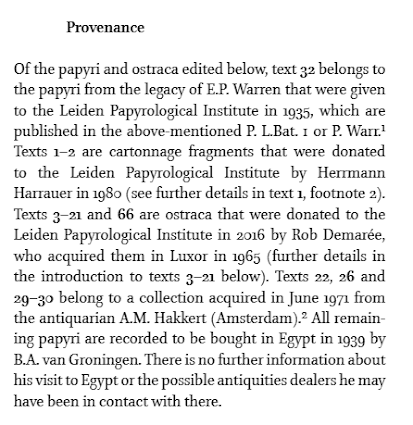
Provenance Details of  P.Leid.Inst. II


[Retrieved from papylist on 23/04/2023]

This volume contains the first edition of 66 papyri and ostraca in the collection of the Leiden Papyrological Institute. The texts are dated between the third century BCE and the eighth century CE and originate from Egypt. They include two Demotic literary papyri (one of which is written in Hieratic script), 19 Demotic ostraca, 44 Greek documentary papyri and one Coptic ostracon.

---

Last week a new publication of Egyptian papyri has been announced in papylist (email list of papyrologists, see experts above) with minimal details about where these artefacts were acquired. 

The papyri are kept at the institute of the papyrology at Leiden University. The publication comes in a time where much of the debate, both publicly and academically, centres on the provenance issue i.e. where and when these materials left the original country. 

It strikes me that the formulations at the introduction are to vague to allow for any real assessment of the legality, if any, or illegality of the material acquired by the institutes in various periods. No references to the documentations provided and no export licences added, at least in the introduction where the matter of provenance is briefly presented. What add insult to injury is the fact that the full details remain behind a paid  wall  of Brill. It is not open-access and therefore I don't have any access to more details on this. It would be a good idea if the Leiden institute considered the idea of sending two or three copies Egypt. Further details on this publication can be found here P.Leid.Inst. II .

 Here is a screenshot of the paragraph I am refereeing to.       


Tuesday, March 1, 2022

MedAfrica

[Retrieved from the website MedAfrica on 1/3/2022]


Archaeological deep history and dynamics of Mediterranean Africa
ca. 9600-700BC


License free image from https://pixabay.com/illustrations/earth-planet-world-globe-1617121/


MedAfrica project sets out to produce the first up-to-date, comprehensive, problematised synthesis and interpretation for a generation of what can be established about long-term social and economic dynamics on the African flank of the Mediterranean between the end of the last glacial (ca. 9600BC) and the arrival of Phoenicians and Greeks (variably 800-600BC), and to identify major factors shaping the patterns detected.

The project is based at the McDonald Institute for Archaeological Research, University of Cambridge, and is funded by the Leverhulme Trust.

More is to be found here MedAfrica.

Saturday, May 1, 2021

Greenhalgh, Plundered Empire : acquiring antiquities from Ottoman lands (Brill 2019)

Plundered Empire

P. XII

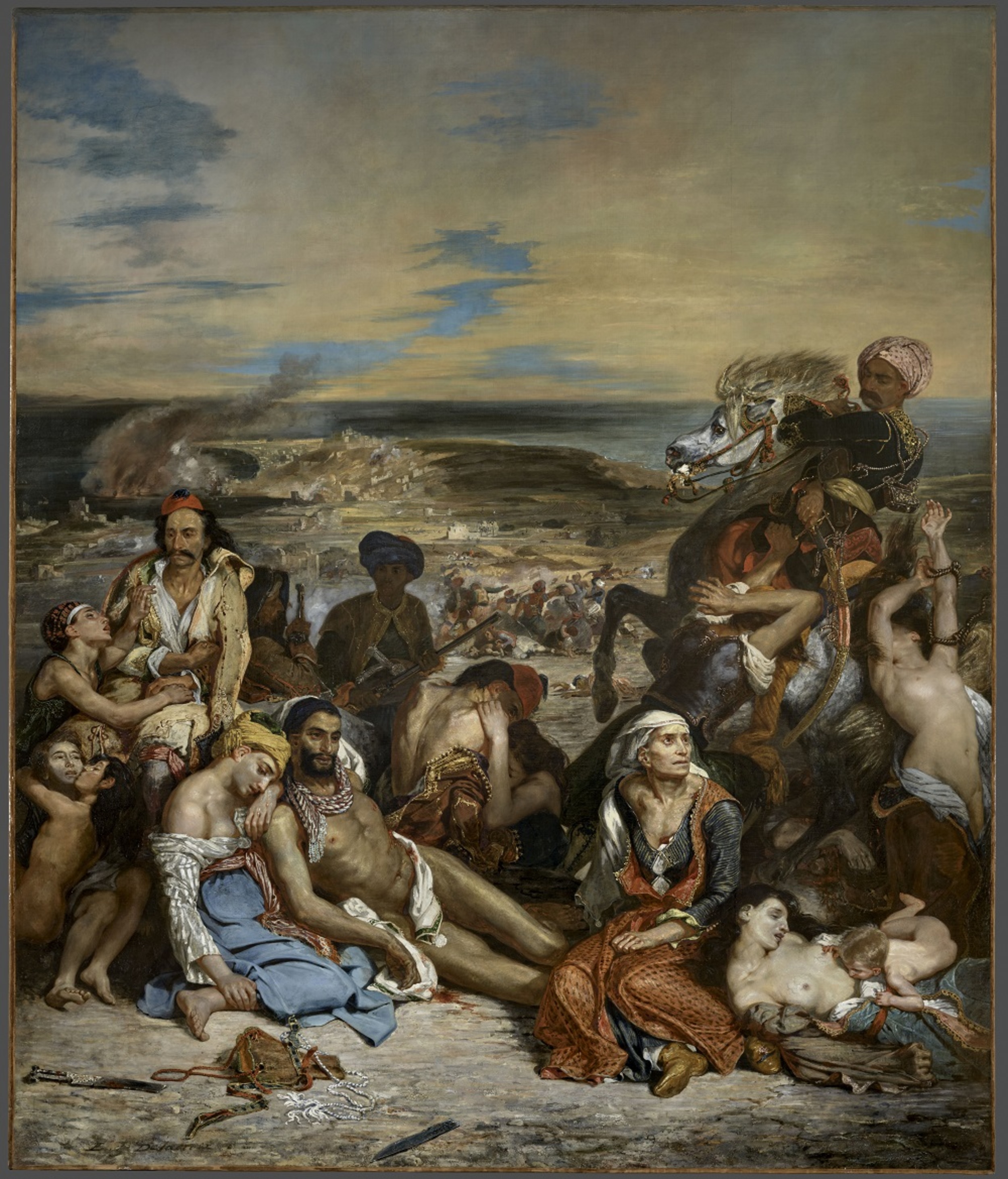
"These describe the trophies from the greatest plunder of all, namely the bloody separation of Greece from Ottoman rule, sold in the West as the liberty gained by innocent Christian Greeks from the cruel and barbarian Muslim yoke. One decisive act was the destruction of Ottoman naval power in 1827 by the navies of Britain, France and Russia at the Battle of Navarino."

Eugène Delacroix - Le Massacre de Scio.jpg
                    The Massacre of Chios, Eugene Delacroix, 1824. From Wikimedia Commons


Monday, April 5, 2021

Byzantine Empire in Arabic - YouTube


Some facts about the Roman Army in Arabic- YouTube


History of the Roman Army (exercitus Romanus) in Arabic- YouTube


Roman Empire in Arabic - YouTube


Greek Civilization-Arabic video with English subtitles


History of Legal practices in Ptolemaic Egypt-Arabic Audio only

مصادر القانون في العصرين الفرعوني والبطالمي - YouTube

Tuesday, July 28, 2020

A Special Program in A Special City: Study in Alexandria

[From the Programm announcement in FB here https://www.facebook.com/Achs.bibalex.org/posts/1835825396555452]

For Arabic Scroll down
--------------------------------------------------------
The Alexandria Center for Hellenistic Studies (ACHS) announces the beginning of registration for Diploma and Master’s degrees in Hellenistic Studies from 4 August–15 September 2020.
This Master’s Program is the fruit of a collaboration between ACHS, the Vardinoyannis Foundation, and Alexandria University, and is available in four modules: History; Literature; Art, Archaeology and Architecture; Philosophy and Science.
English is the teaching language.
The Alexandria Center for Hellenistic Studies, in cooperation with the Vardinoyannis Foundation, provides a grant of 75% of the tuition fees to applicants (Terms apply).
Admission requires a BA in Classics, Archaeology or equivalent degrees from an accredited university in Egypt with Good Grade minimum. Those with the aforementioned BAs may apply directly for a Master’s degree. Non-specialized graduates must enroll in a one-year qualifying diploma.
The Center interests itself in the era when Alexandria flourished; namely, from its construction until the end of the Ptolemaic period.
For more information, please contact the Alexandria Center for Hellenistic Studies:
Tel.: + (203) 4839999, Ext. 1920
E-mail: hellenistic.studies@bibalex.org

Monday, July 13, 2020

Database Objects from Coptos

From Papylist messages [13/07/2020]

Dear colleagues,

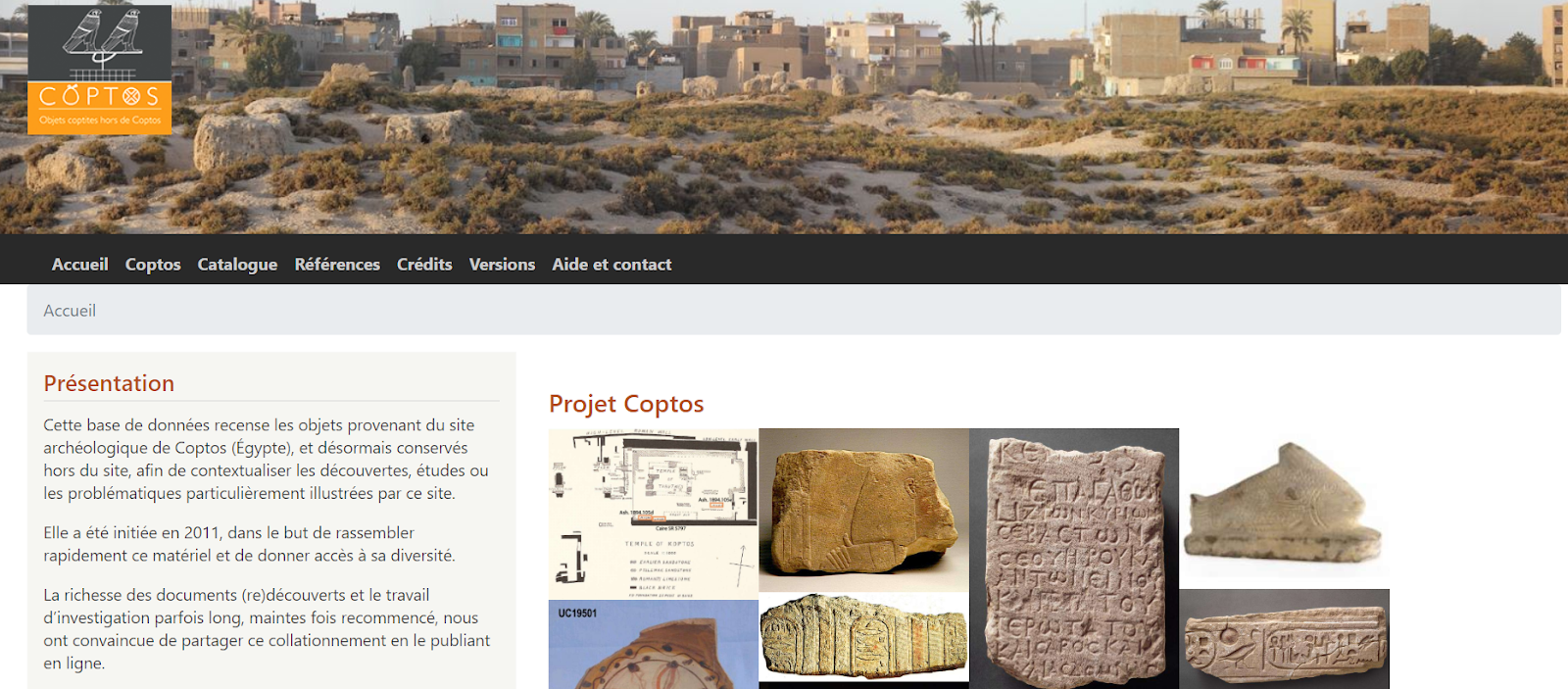
During several years, Vanessa Desclaux has collected information about more than 1700 objects from the site of Coptos now preserved in various museums, together with their bibliography. We are pleased to announce the publication of this database in its first version:
We hope this tool will be useful for further research. 

With our best wishes,

Laure Pantalacci & Vanessa Desclaux

The Invention and Reinvention of the Egyptian Peasant

The Egyptian Peasant

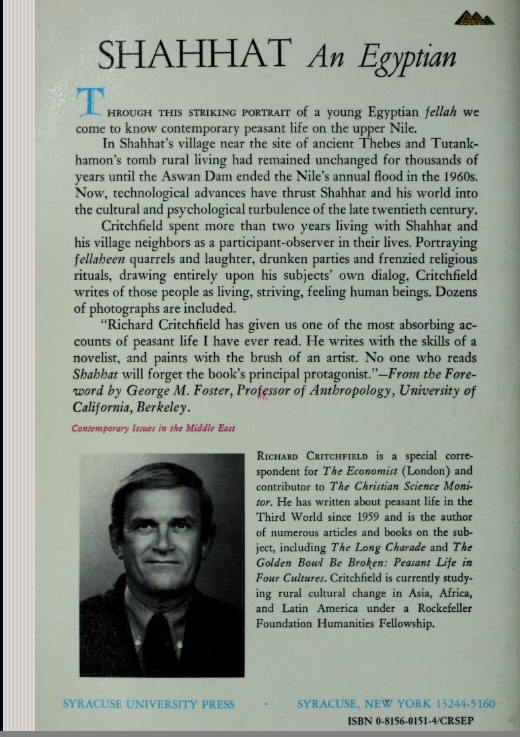
I wonder if my father has ever read Richard Critchfield's Shahhat: An Egyptian 1978 (in a translated form maybe?), or the colonial eurocentric discourse was so overwhelming, so that he kept reminding me that our village, like any other Egyptian village, barley has a name?

I am more inclined to accept the second guess since he was a government official, first in the village administration council and eventually int he nearby town council,  and most probably had this idea from his predecessors and colleagues, before making it his own motto. Cf. Timothy Mitchell,The Invention and Reinvention of the Egyptian Peasant, International Journal of Middle East Studies, Vol. 22, No. 2 (May, 1990), p. 132-133, where he speaks of Critchfield's portrait of Shahhat, a village in Luxor near Kings' valley: 


Thursday, July 9, 2020

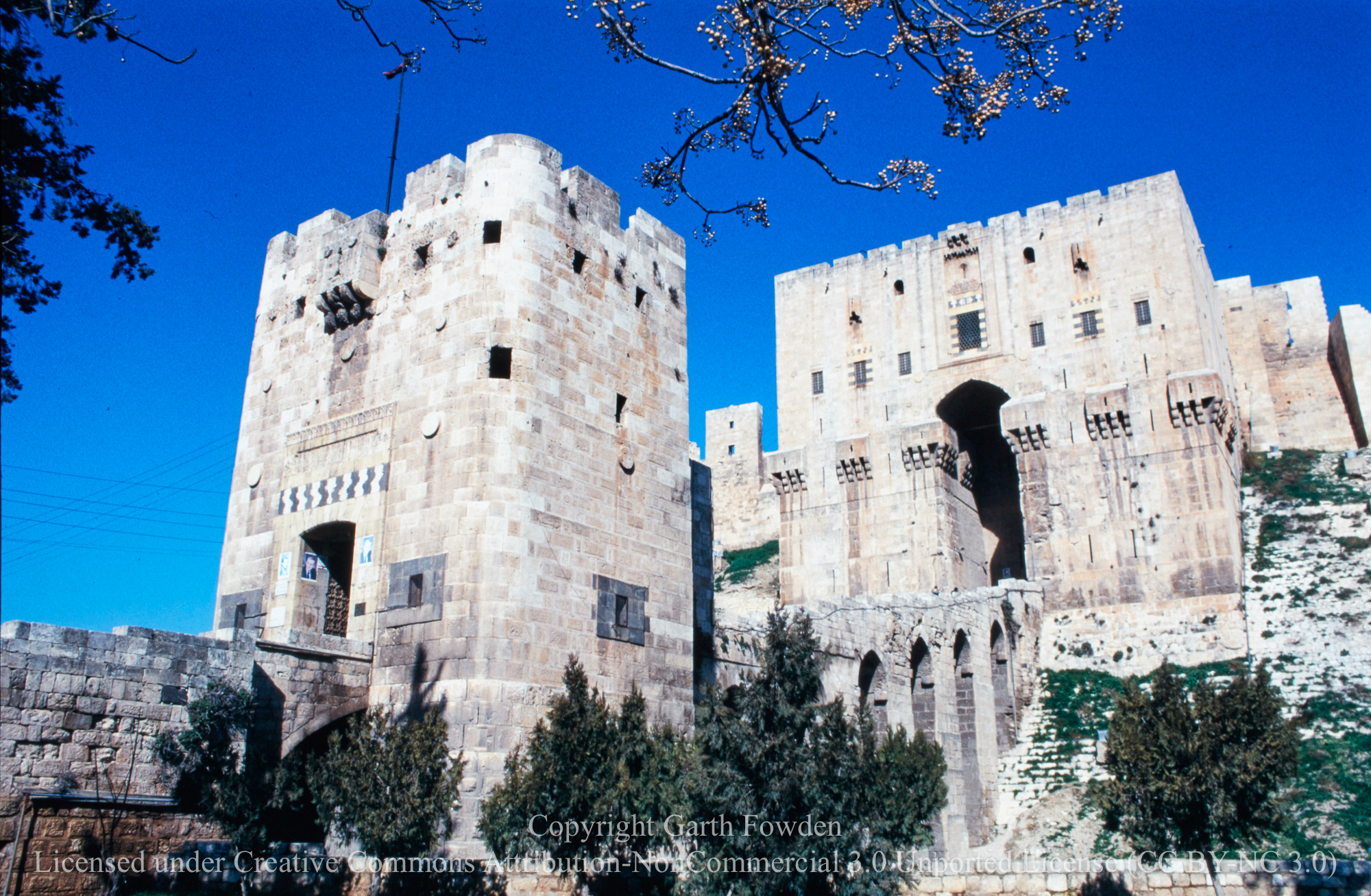
The Digital Photographic Archive of Professor Garth Fowden FBA

Fowden's Digital Photographic Archive  


[From the website (accessed 09/07/2020)]

The photographic archive he assembled during travels mainly in the Middle East and Greece has been digitized by Cambridge University Library and was published on-line in February 2018:  https://cudl.lib.cam.ac.uk/collections/landscapes/1.

Garth Fowden is a historian of first millennium CE Eurasia, who in pursuit of his interests has travelled extensively in the Mediterranean, the Middle East and North Africa. For the greater part of his career he has lived and worked in Greece. This site presents a digitized version of the photographic archive he developed while conducting research on the landscapes and monuments of these regions.

....

From 1977 Fowden began to travel systematically in the Middle East including Turkey, but photography did not become a priority until 1986. The latest items in the archive date from 2007. The main regions covered are Greece, Turkey, Syria, Jordan, Iran and Yemen, and less extensively Spain, Italy, Lebanon, Palestine and Egypt. The strengths of the collection, reflecting Fowden's research and teaching interests at different periods, are: 
- the relationship between settlement and landscape; 
- fortification, and the evolution of the urban tissue, especially in the late Roman period; 
- religious architecture, especially the conversion of holy places, monasticism, and the emergence of Islam; 
- art and epigraphy preserved in architectural or archaeological contexts;
- traditional  domestic architecture. 
Within each site, the photographs are arranged in a sequence designed to convey some sense of a physical visit, sometimes starting and/or ending with more general shots of the surrounding landscape and of the routes that traverse it. Photographs taken on site are occasionally supplemented by items from museums or print publications designed to make the collection more suitable for teaching purposes.
The documentation of Palmyra, Aleppo (where Fowden spent the first half of 1996 as the guest of the Syrian Orthodox Archbishop Mar Gregorios Yohanna Ibrahim), and the Yemen, has particular value and poignancy in the light of recent events. Even more than war, though, it has been urbanization, the construction of dams, and the extensive irrigation of formerly arid areas, that has transformed the region in recent decades. Many of the places recorded will be inaccessible to foreign visitors for the foreseeable future, and are anyway changed beyond recognition.
For a brief introduction to the archive’s background and themes, and a sampling of its contents, click here

Tuesday, July 7, 2020

Open Access to Classical Papers, the journal of Cairo University's Greek and Latin department

Classical Papers

Vol. I (1991)- XIX (2019)

Classical Papers (CP), the Journal of Cairo University's Department of Greek and Latin (founded by Taha Hussein) is now available online (open-Access: https://preview.tinyurl.com/y83dqdzf ). The volumes doesn't date back to Hussein's pioneering days, but builds upon his Legacy. It is therefore counted as one of the leading journals in Egypt's Classics.