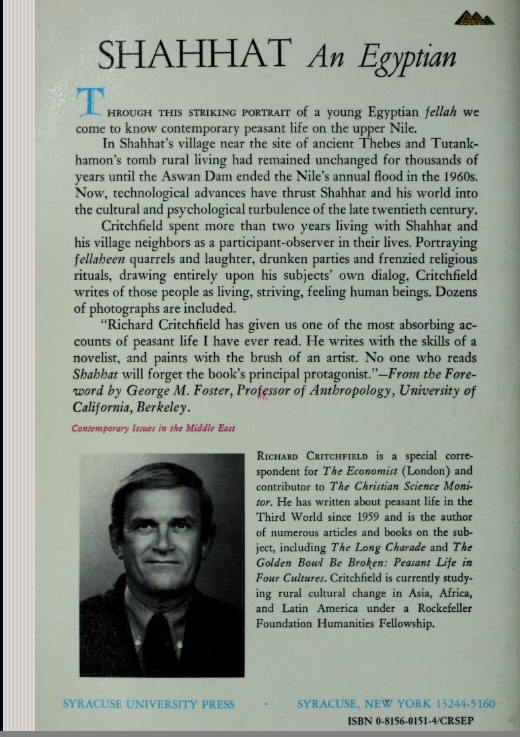
فى ختام كتابه الجميل الأدب اللاتينى ودوره الحضارى ، تحدث الدكتور أحمد عتمان عن ضرورة المضى قدماً فى كتابة تاريخ للأدب اللايتينى فى عصره الفضى مروراً بالعصر البيزنطي ووصولاً، كما ذكر، إلى لاتينية العصور الوسطي. وشرح أسباب هذه الضرورة.
The blog aggregates news about publications, activities, etc. related to Egyptian/Arabic scholarship in the field of Greco-Roman studies and thus seeks to challenge the Eurocentrism prevalent in the field. It aims also at directing the attention to relevant materials from modern nonacademic/public contexts; roughly from 1798-to the present. The news comes mainly from Egypt without excluding other Arabic countries.
فى ختام كتابه الجميل الأدب اللاتينى ودوره الحضارى ، تحدث الدكتور أحمد عتمان عن ضرورة المضى قدماً فى كتابة تاريخ للأدب اللايتينى فى عصره الفضى مروراً بالعصر البيزنطي ووصولاً، كما ذكر، إلى لاتينية العصور الوسطي. وشرح أسباب هذه الضرورة.
نمط معروف
Information regarding the provenance of papyrological material that was acquired in the Egyptian antiquities market in the late nineteenth and early twentieth centuries is scarce and often unreliable. This article investigates the provenance of Hamburg’s Papyrus Bilinguis 1, famed for containing the apocryphal Acta Pauli. By researching archival files documenting the acquisition and the context of the find, the papyrus is shown to have been acquired in breach of the Egyptian antiquities law of 1912. The article reveals how Carl Schmidt (1868–1938), the collector who acquired the manuscript for the Hamburg library, by concealing information, tried to cover up his own criminal involvement in the smuggling of the manuscript. Through the investigation of a manuscript that was acquired by a public German institution in awareness of its illegality, the article hopes to contribute to current debates on the translocation of cultural heritage artefacts to Europe and the US in the age of European colonialism and imperialism.
[Retrieved from papylist on 23/04/2023]
This volume contains the first edition of 66 papyri and ostraca in the collection of the Leiden Papyrological Institute. The texts are dated between the third century BCE and the eighth century CE and originate from Egypt. They include two Demotic literary papyri (one of which is written in Hieratic script), 19 Demotic ostraca, 44 Greek documentary papyri and one Coptic ostracon.
---
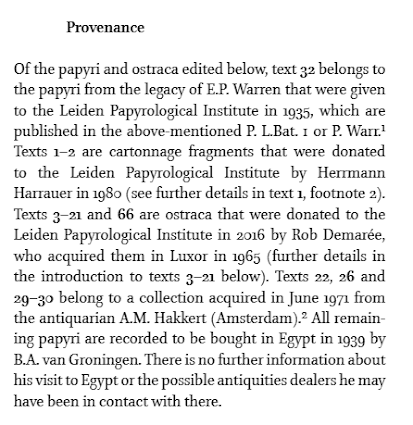
Last week a new publication of Egyptian papyri has been announced in papylist (email list of papyrologists, see experts above) with minimal details about where these artefacts were acquired.
The papyri are kept at the institute of the papyrology at Leiden University. The publication comes in a time where much of the debate, both publicly and academically, centres on the provenance issue i.e. where and when these materials left the original country.
It strikes me that the formulations at the introduction are to vague to allow for any real assessment of the legality, if any, or illegality of the material acquired by the institutes in various periods. No references to the documentations provided and no export licences added, at least in the introduction where the matter of provenance is briefly presented. What add insult to injury is the fact that the full details remain behind a paid wall of Brill. It is not open-access and therefore I don't have any access to more details on this. It would be a good idea if the Leiden institute considered the idea of sending two or three copies Egypt. Further details on this publication can be found here P.Leid.Inst. II .
Here is a screenshot of the paragraph I am refereeing to.
| License free image from https://pixabay.com/illustrations/earth-planet-world-globe-1617121/ |
The project is based at the McDonald Institute for Archaeological Research, University of Cambridge, and is funded by the Leverhulme Trust.
More is to be found here MedAfrica.
Dear colleagues,
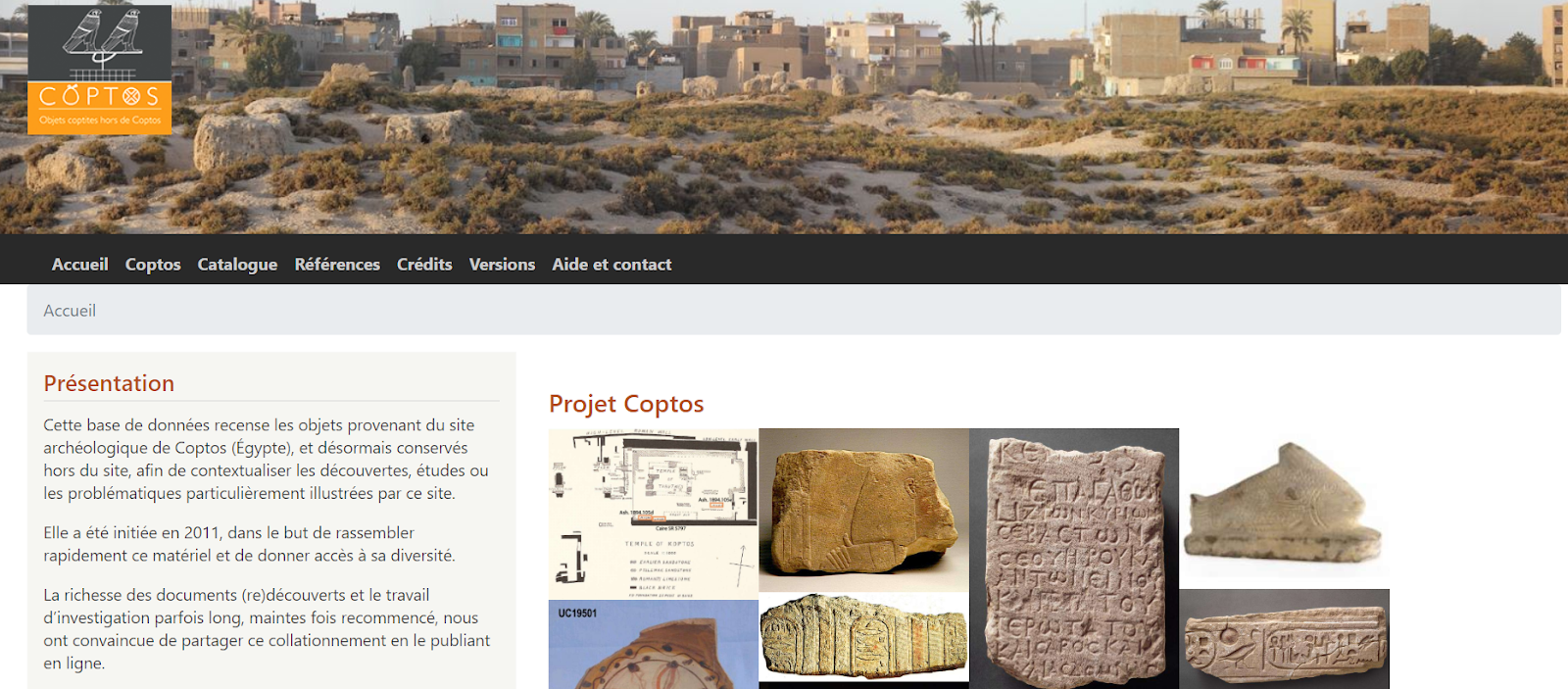
During several years, Vanessa Desclaux has collected information about more than 1700 objects from the site of Coptos now preserved in various museums, together with their bibliography. We are pleased to announce the publication of this database in its first version:
We hope this tool will be useful for further research.
With our best wishes,
Laure Pantalacci & Vanessa Desclaux

It's usually reported, not infrequently with astonishing confidence, that the Egyptian school of Greco-Roman Studies is a peripheral. Yet I wonder how this conclusion came 2 exist while its publications r not included either n L'Année philologique o n Bibligraphie Papyrologique!— Usama A. Gad (@usamaligad) November 20, 2018